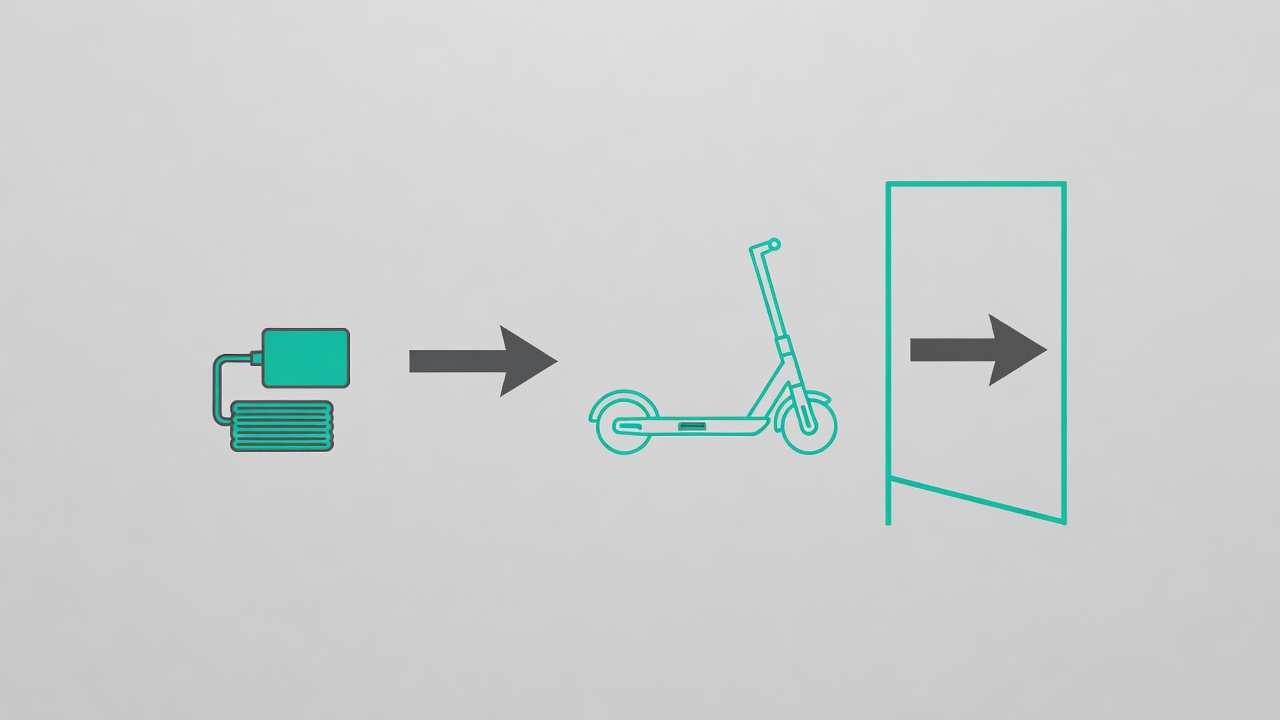
Treat advertised range as a test result
A manufacturer’s range figure usually comes from defined conditions. Those conditions may include a light rider, a particular riding mode, a level surface and mild weather. Your commute adds its own variables: stops, gradients, headwinds, luggage, colder air and ageing components. Two scooters tested differently cannot be compared fairly by their largest range numbers alone.
Ask for the test method, then establish your own baseline on short journeys with an easy return option. Keep a simple note of distance, conditions, riding mode and the battery indication before and after. The display is an estimate, not a laboratory measurement, so avoid planning a route that depends on the final bar. Preserve a reserve for detours and changes in weather rather than adopting a universal percentage from an unrelated model.
Understand the label without overpromising
Watt-hours describe stored electrical energy. When nominal voltage and amp-hours refer to the same pack rating, multiplying them gives an approximate watt-hour figure. That can help compare capacity, but usable energy and system efficiency still vary. Motor wattage describes a different characteristic; a larger motor number does not directly tell you how far a scooter will travel.
Battery chemistry, cell quality, thermal management and the battery management system also matter. A chemistry label alone cannot establish that a product is safer or longer-lasting. Emerging battery technologies are worth watching, but commuter decisions should rest on documented product information, verified safety claims, repair support and suitability for the route. Avoid paying for an unsupported promise about a breakthrough cell.
Make charging a deliberate routine
Use only the charger supplied or explicitly approved by the manufacturer for the exact battery system. Similar connectors can hide different voltages, polarity or charging behaviour. Inspect the charger, cable and socket before use. Do not use damaged equipment, improvised adapters or a charger advertised as universal without verified compatibility.
Choose a dry, stable location away from combustible materials and escape routes, following the manual and applicable building rules. Do not cover the charger or battery. Charge while you are awake and able to notice a problem, not while sleeping or away from the property. Follow the manufacturer’s connection sequence and disconnect when charging is complete. A battery management system does not make unattended charging risk-free.
Temperature limits are model-specific. After a demanding ride, allow the pack to return to the manufacturer’s permitted charging range. A scooter brought in from the cold may also need time to reach an appropriate temperature. Do not invent a fixed waiting period: consult the manual, and never apply external heat to hurry the process.
Store for the next useful ride
For a break from riding, follow the manufacturer’s storage charge level and inspection interval. There is no single percentage or schedule suitable for every scooter. Store in the recommended temperature range, away from moisture, direct heat and escape routes. A battery can lose charge while unused, so a forgotten scooter is not necessarily ready simply because it was charged before storage.
Reduced range does not automatically mean the pack needs replacement. Check approved tyre pressures, brake drag, riding conditions and changes in load first. Persistent problems, sudden shutdowns or charging errors deserve assessment by the manufacturer or a qualified service provider. Do not open a battery enclosure, replace individual cells or bypass protective electronics as a home troubleshooting exercise.
Check claims and plan the end of service
UL 2272 and UL 2271 address different parts of the safety picture: electrical systems for personal e-mobility devices and batteries for light electric vehicle applications respectively. Confirm the exact product and scope of any certification, rather than assuming that a certified component means the entire scooter is certified. Local sale, building and charging requirements may impose additional conditions.
When a pack reaches the end of useful service, use an authorised collection route for lithium-ion batteries. Do not put it in household rubbish or ordinary mixed recycling. A damaged pack may require special arrangements, so contact the collection service before travelling with it. Keep the battery identification and scooter model details available to help the service give appropriate instructions.
Build a power budget around reality
A dependable battery routine is quiet: a route you have tested, a charger you can identify, a suitable location and a backup plan. If workplace charging is essential, obtain permission and confirm the actual rules rather than assuming an unused socket is available. If those conditions cannot be met, shorten the scooter leg or choose another connection. Reliability comes from the whole arrangement, not capacity alone.