Write a commute brief first
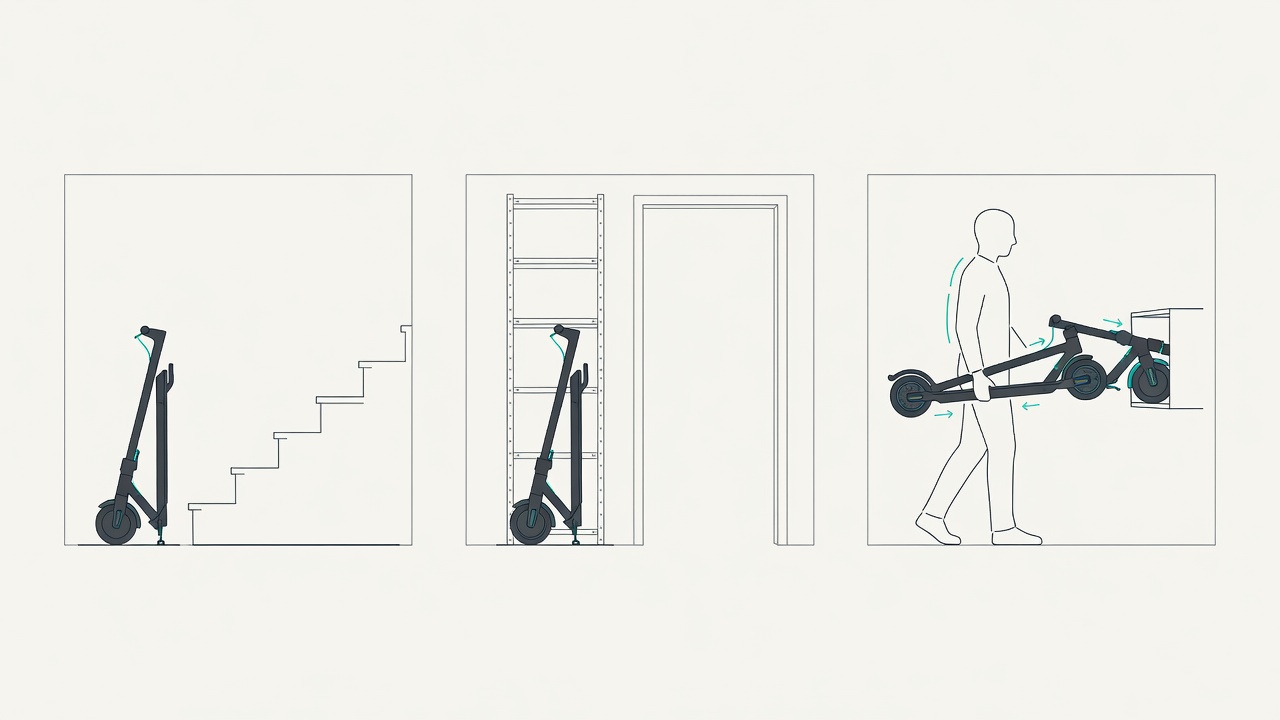
List the journeys you expect to make regularly, not the occasional outing you would like to imagine. Note the distance in each direction, unavoidable hills, rough surfaces, staircases and any train or bus connection. Add your usual luggage and the place where the scooter will wait during the day. These details turn a long product list into a shorter set of practical requirements.
Separate requirements from preferences. Fitting into a permitted storage area may be essential; a particular display design is probably optional. If the scooter must travel on public transport, check the operator’s current conditions before comparing folded dimensions. Some operators restrict electric scooters regardless of whether they fold. A compact vehicle is not automatically an accepted one.
Test the lift, not just the fold
Published weight is useful, but the shape of the load matters too. A long stem can swing, a rear wheel can catch clothing, and a carry point can leave the deck tilted against your leg. If possible, handle a demonstration model with permission. Lift it from the floor, hold it briefly and consider whether the same movement remains comfortable after a full working day.
Measure the folded length, width and height against your actual storage space. Leave room for doors, ventilation and a safe walking route. Check how the folding latch engages and how the manufacturer says to inspect it. Do not use a carry hook or improvised strap unless it is designed for the model and the intended load. A loose hinge is a repair issue, not an invitation to tighten random bolts.
Match the wheels and brakes to the route
Small wheels react strongly to potholes, raised edges and poor surfaces. Larger wheels may improve obstacle handling, but they do not remove the need to slow down and choose a safe line. Pneumatic tyres can provide useful cushioning, while solid tyres avoid punctures but may transmit more vibration. Suspension adds another variable, along with weight, maintenance and the availability of replacement parts.
Look beyond the number of brake systems in a product listing. Ask how each brake operates, what routine adjustment it needs and which components wear out. Learn the controls in a permitted, low-risk location before attempting a busy commute. Never assume a claimed motor power or electronic brake feature guarantees a particular stopping distance. Grip, rider position, surface conditions and maintenance all matter.
Read specifications in context
A maximum load rating is not a target. Include yourself, clothing, a bag and anything else carried, then follow the manufacturer’s limits. Hill-climbing claims also need context: rider mass, gradient, battery state and duration can change the result. If a seller cannot explain its test conditions, do not treat an impressive number as evidence that the scooter will handle your particular climb.
| Specification | Question to ask |
|---|---|
| Weight and folded size | Can I safely lift and store it at both ends? |
| Tyres and brakes | What care and replacement parts do they need? |
| Water resistance | What use does the manual actually permit? |
| Battery and charger | Is an approved replacement available? |
| Warranty | Who handles repairs, and what is excluded? |
Buy the support system too
Before ordering, find the model’s manual and identify a credible repair route. Ask about tyre availability, brake pads, folding components and battery servicing. A low purchase price can become expensive when a minor consumable is unavailable or every repair requires difficult shipping. Check the seller’s return process, especially if you cannot examine the scooter in person.
For electrical safety, understand exactly what a certification claim covers. UL 2272 concerns electrical systems for personal e-mobility devices; UL 2271 concerns batteries for light electric vehicle applications. A logo in a listing is not, by itself, independent verification of the exact model. Consult the certification body’s directory where available. Certification does not grant road access or replace proper charging and maintenance.
Make the final choice ordinary
Imagine a wet forecast, a busy lift and a tired journey home. Would you still choose this scooter? A good daily fit remains workable when the day is unremarkable rather than ideal. If the answer depends on bypassing transit rules, charging in a corridor or carrying more than you can comfortably handle, change the plan before changing the specification.
Your shortlist may end with a lighter scooter, a different route, shared mobility for occasional trips or no scooter at all. That is a useful outcome. The point is a reliable connection between places, not ownership for its own sake.